Showing posts with label Benin Royal Art. Show all posts

Friday, April 17, 2020

Looted Benin Objects to be Published Online

87440
Standing Figure, Benin Kingdom, c. 17th century
Collection of University of Pennsylvania Museum of Archaeology and Anthropology

In the fight to get museums in Europe and America to take seriously the matter of restituting important African art and cultural objects stolen or looted from the continent in the age of colonialism, there is small but significant progress.
It has just been announced that the Museum am Rothenbaum, Hamburg will publish online all known Benin objects in various media looted by British soldiers in that infamous invasion of the kingdom in 1897. Funded by a generous grant from the Ernst von Siemens art foundation, the project, under the auspices of the Benin Dialog Group, is significant, as it will provide scholars, activists, and institutions interested in the question of the Benin loots--since scattered in major museums around the western world--a comprehensive accounting of who is keeping what of these exiled objects. Until now, such information is buried mostly in barely illustrated scholarly books accessible only to a very small group of academics in universities and museums.
I hope that the goal of this project is to provide images of all the documented works. For with such a visual catalogue, the enormity and scale of that historic plunder of a kingdom will become all the more visibly evident.

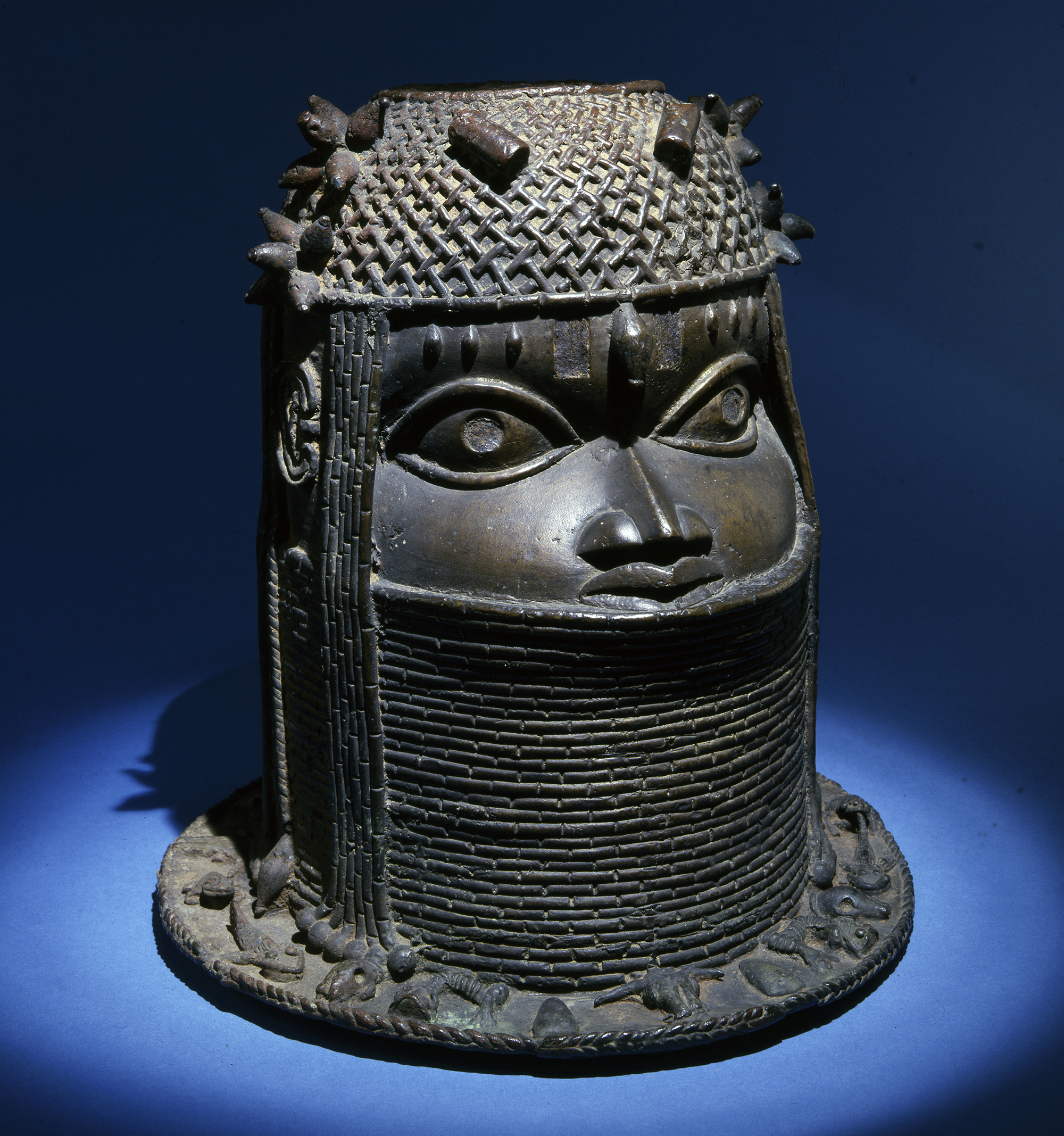
Head of an Oba, brass. Collection of Field Museum, Chicago
But, I wonder. As I noted in a post on the subject early last year, the fact that US museums are missing in action is beyond scandalous. Notice that the announcement about the Hamburg project lists only the big European museums with huge caches of the Benin loots, including Hamburg's Museum am Rothenbaum, the British Museum, Berlin’s Ethnology Museum, Vienna’s Weltmuseum and the National Museum of World Cultures in Leiden.
Where the hell are American Museums, including the Metropolitan Museum of Art, Field Museum Chicago, Boston's Museum of Fine Arts, Philadelphia's Penn Museum, and Brooklyn Museum? What are they doing about the looted Benin objects they are keeping in their galleries and vaults? When will they tell us what they intend to do about their own loots?

For more on the Hamburg project, click here

Saturday, February 9, 2019

On Looted African Art: Are US Museums Playing the Ostrich?

When it comes to the question of returning looted African art and Benin Royal treasures, American museums are playing the ostrich. But for how long?
Collection: Ethnological Museum, Berlin
Photo: Chika Okeke-Agulu


Just about ten years ago, influential voices in the US artworld told us that art and cultural heritage from anywhere in the world belong to all humanity and therefore must be kept safe in fabulous universal museums in Europe and America that had amassed them primarily during the era of colonization.

It did not matter much, the argument went, how these objects, many of significant value to the communities, cultures, nations and states that originally owned them, ended up in these well-heeled museums. They all but wanted to be patted on the back as generous caretakers of global artistic and cultural heritage. Thankfully, few believed there was something strange, wrong and arrogant about this argument. But they were seen as purveyors of fringe thinking, inebriated by left-brewed, postcolonial theory Kool-Aid. Not anymore.

Two recent developments in Europe, one by the French government, the other by the Benin Dialogue Group (BDG), established by a handful of major museums, have returned this debate to the center stage. But the Americans are MIA!

On November 28, 2017 in Ouagadougou, capital city the West African nation of Burkina Faso, French President Emmanuel Macron made history. First, he, the leader of a leading European nation, acknowledged that colonization was, for the colonized, a bad experience.

Second, he demolished the notion that European museums had a duty and right to keep art objects that filled their storage rooms and galleries, mostly acquired as part of Europe’s colonial-era pillaging of Africa’s cultural heritage. “African cultural heritage,” he said, “can no longer remain a prisoner of European Museums.” Holding on to these objects, Macron implied, perpetuates the violence and injustice of colonization, and is thus indefensible. In five years, he announced, these prisoners should go home! This is huge.   

But many were skeptical. What politics moved the French president to apologize for the evils of French colonialism and promise to return his country’s vast holdings of African art? Whatever made him do this, there is no question that it is a game changer.

This November, two scholars—Senegalese, Felwynn Sarr, and Benedicte Savory, French—appointed by Macron released their much-awaited report, a sort of action plan, on the restitution of African cultural heritage in French collections. Macron not only accepted it, he announced the immediate return of several prized royal objects looted in 1892 by the French army from the Dahomey Palace in today’s Republic of Benin.

Whereas the Macron-French solution to the problem of looted African art is dramatic, and quick-paced, and, some say, too precariously tied to the whims of their current head of state, that of the BDG is, well, in slow mo.

The decade-old BDG, eight museums in all, led by the British Museum London, Ethnologisches Museum, Berlin, and the Museum am Rothenbaum, Kulturen und Künste der Welt (MARKK), Hamburg—Europe’s heavies—is concerned only about Benin Royal art. There is good reason for this. In 1897, in a so-called Punitive Expedition, the British army burned the vast Benin palace in today’s southern Nigeria. They looted thousands of centuries-old brass, ivory and art objects, and within a year the state auctioned off the entire thing to pay for the military campaign. The BDG museums now hold a lot of these looted stuff, and so are American big players like The Met, Chicago’s Field Museum, Museum of Fine Arts, Boston, and Smithsonian National Museum of African Art in Washington, DC.

The BDG, critical of the Macron-French plan, see theirs as the real thing. They point to the fact that representatives of the Benin King and the Nigerian government are in the group. That one is the outcome of a presidential fiat, a one-man show; the other a dialogue of partners. They have a point. And just a few months ago, they announced their big plan: to support the building of a royal museum in Benin City in three years, train its staff and--here’s the deal--loan some of the looted objects to it. 
Collection: Ethnological Museum, Berlin
Photo: Chika Okeke-Agulu

This sound great.

But there are is big problem with the BDG solution. How do you lend stolen objects back to its owner? Might not the Nigerians, by accepting these treasures on loan, be giving up their inalienable ownership claims? The group insists that this is not the case, but many are rightfully worried, still.
Say what you will though about the Europeans, they are engaged result-oriented actions, to right a historic wrong. Americans do not seem to think current restitution hoopla is their cup of tea. On this side of the Atlantic there is an indefensible silence. Perhaps they are waiting this out, comforted by the silly idea that their European cousins supervised the looting of African cultural heritage in the age of empire and must clean up their postcolonial mess.

In truth, American opinion has changed somewhat. Now it goes something like this: only in Europe where museums are state institutions, art and culture socialized, could the Macron type of political intervention be possible. They say that US museums, owned by private and corporate entities, cannot be bound by the government-level decisions, negotiations and agreements of any type. This at best is a convenient excuse. At worse they care less about African concerns.

Twenty years ago, representatives of forty-four countries, gathered in the US capital, signed the non-binding but historic Washington Principles—a set of guidelines for the return of art treasures looted by the Nazis from Jewish families. And just two years ago, the Holocaust Expropriated Art Recovery (HEAR) Act became law to power up restitution claims that have had mixed results two decades on.
The point here is that US government and US museums have in fact seriously engaged in return of stolen cultural properties, but not those from Africa. Why? Perhaps because the African claimants do not have the kind of voice that gets to the ears of American cultural establishment? Or maybe Africa doesn't matter that much to them?

Last November at a symposium on colonialism and looted African cultural heritage at the Berlin Ethnological Museum, I heard someone justify the American commitment to the return of Nazi loots and not African treasures seized by European colonial powers. It was said that their restitution is necessary because, apart from doing the right thing for Jewish victims of Nazi terror, and possible because there’s good information about specific owners of the seized items. The same argument can be made for Africa.

African colonization was accompanied by systematic violence—of the killing, burning, and sacking of communities and kingdoms--but also destruction of cultures, traditions and social systems that sustained them. Moreover, we know when and where many expropriated African treasures came from and which public museums (and private collections) in the US and Europe have them.


So, here is a renewed call to trustees of American museums and the state-owned Smithsonian: since the loots from Benin palace in 1897 are very well documented, and the kingdom has repeatedly demanded the return of its art treasures, it is time to do the right thing. Either they join the BDG, emulate the French, or come up with their own better plan, binding or not. The clamor for the return of Benin Royal and African art is not going away; time’s up.   

Thursday, July 12, 2012

The Robert Lehman Gift to the Museum of Fine Arts in Boston: Matters Arising (HuffPost)


Commemorative head of a defeated neighboring leader, Edo peoples, Benin kingdom, Nigeria, late 15th-early 16th century, *Robert Owen Lehman Collection, *Courtesy, Museum of Fine Arts, Boston
The Museum of Fine Arts, Boston (MFA) has just become a major player among collections of the famed Royal Benin brass and ivory sculptures, thanks to the gift of 34 objects by Robert Owen Lehman. And the MFA and its publics are justifiably thrilled because until this gift the museum had only one Benin object in its 20-year-old African collection. Plans are on to build a dedicated permanent gallery for the Lehman Collection. 

As a student of Benin art, this is great news, and I cannot wait to see this collection when it opens to the public in late 2013. It is unquestionably to the benefit of Benin art scholarship and enthusiasts that the Lehman Collection, which has more or less been off the radar, will now be accessible to students and scholars -- excluding of course(!) those from Africa who would never get travel visas to visit the MFA, or any other American museum for that matter. And who knows what new scholarship the collection might inspire? 
Commemorative head of an Oba (King), Edo peoples, Benin kingdom, Nigeria, late 16th century, *Robert Owen Lehman Collection, *Courtesy, Museum of Fine Arts, Boston
Still, each time I read news about Benin works that were originally looted in 1897 from the Palace of Oba Ovonramwen, the great-grandfather of the present Oba Erediauwa of the Benin Kingdom, it is impossible forget that the fate of these artworks remains unresolved. Of course, western institutions and governments have carefully managed the laws governing cultural heritage, and imposed arbitrary dates that give legal cover to museums holding works such as those from the Benin Court. But there are ethical imperatives that cannot be glossed over by stupid legal regimes. 

One thing is certain: Calls for the resolution of the problem caused by British looters of Benin royal art collection will not go away -- especially now that Nigerian/world-citizen voices have learned to harness the popular power of the internet to demand action, with occasional victories. 

Pectoral showing two officials, Edo peoples, Benin kingdom, Nigeria, 16th-17th century, *Robert Owen Lehman Collection, *Courtesy, Museum of Fine Arts, Boston
Take for instance what happened in late 2010 when the heirs of Lieutenant-Colonel Henry Galway, one of the leaders of the so-called Benin Punitive Expedition, quietly consigned several objects, including an extremely rare ivory pendant "Queen Idia" mask, taken from the Benin Court by their ancestor, to the Sotheby's London for sale. When bloggers, journalists and cultural critics petitioned the Sotheby's to reconsider its participation in the Galway transaction, we were told that the auction would go on. But when the clamor heated up fueled by an international signature campaign, Sotheby's cancelled the sale -- or rather, the Galway heirs withdrew the consignment. 

This time around, some commentators have tried to equate the Galway-Sotheby's saga with the Lehman-MFA gift. But I think these are not quite the same, given that, according to the MFA press announcement, Mr. Lehman bought all the works in his Benin collection from the art market between the 1950s and 1970s. Where the Galway family simply wanted to make lots of money from their looted inheritance (and given the controversy surrounding the auction, I could not imagine any self-respecting public institution touching them with a long pole, which means they most likely would have disappeared into private collections, not to be seen again for a long time), Mr. Lehman moved his collection to a public museum, where the works will be available to anyone interested in them. 
Relief plaque showing a battle scene, Edo peoples, Benin kingdom, Nigeria, 1550-1650, *Robert Owen Lehman Collection, *Courtesy, Museum of Fine Arts, Boston
So, under the circumstances, it will be good to see these 34 works -- which include some first-rate examples of Benin Court art -- at the MFA when the dedicated gallery opens in 2013. The thing though is that, by acquiring this important collection, the MFA joins other top-tier western museums (the Met, Art Institute of Chicago, British Museum, the Berlin, and Vienna Ethnological Museums, etc.) that must bear the burden of resolving the ethical quagmire that is Benin Royal Art, no matter how passionately James Cuno and others like him want to claim expropriated art by colonial powers for the so-called global (read Euro-American) encyclopedic museums.

There are small, significant steps that can be taken in the meantime, and there is some indication that the MFA may be willing to begin. According to Christraud Geary, the respected Teel Senior Curator of African and Oceanic Art, the Lehman Collection installation will fully explore the circumstances under which the objects were taken from Benin City. That is to say, the MFA will not ignore (or relegate to a footnote as some other collections have) the problematic history of the Benin objects in their collection; and the Court and Benin communities will be consulted in the process. I would hope that the museum will find the courage to go further than this. 

Saltcellar, Sapi peoples, Sierra Leone and Guinea, late 15th-early 16th century, *Robert Owen Lehman Collection, *Courtesy, Museum of Fine Arts, Boston
At the 2007 opening of the groundbreaking, comprehensive Benin: Kings and Ritual exhibition at the Museum of Ethnology, Vienna, Oba Erediauwa stated that while the Benin Court is not necessarily demanding the repatriation all the objects looted by the British, it wishes to enter into workable, mutual understanding with museums holding these objects such that there could be temporary loans to the Court where these objects (actually their replacements produced after the restoration of the kingdom in 1914) remain a vital part of the ritual and social life of the Oba and the Edo Kingdom. But will museums holding Benin Court's works of art explore this commonsense, ethical route?